Disclosure: This site may contain affiliate links. If you purchase through these links, we may earn a commission at no additional cost to you.
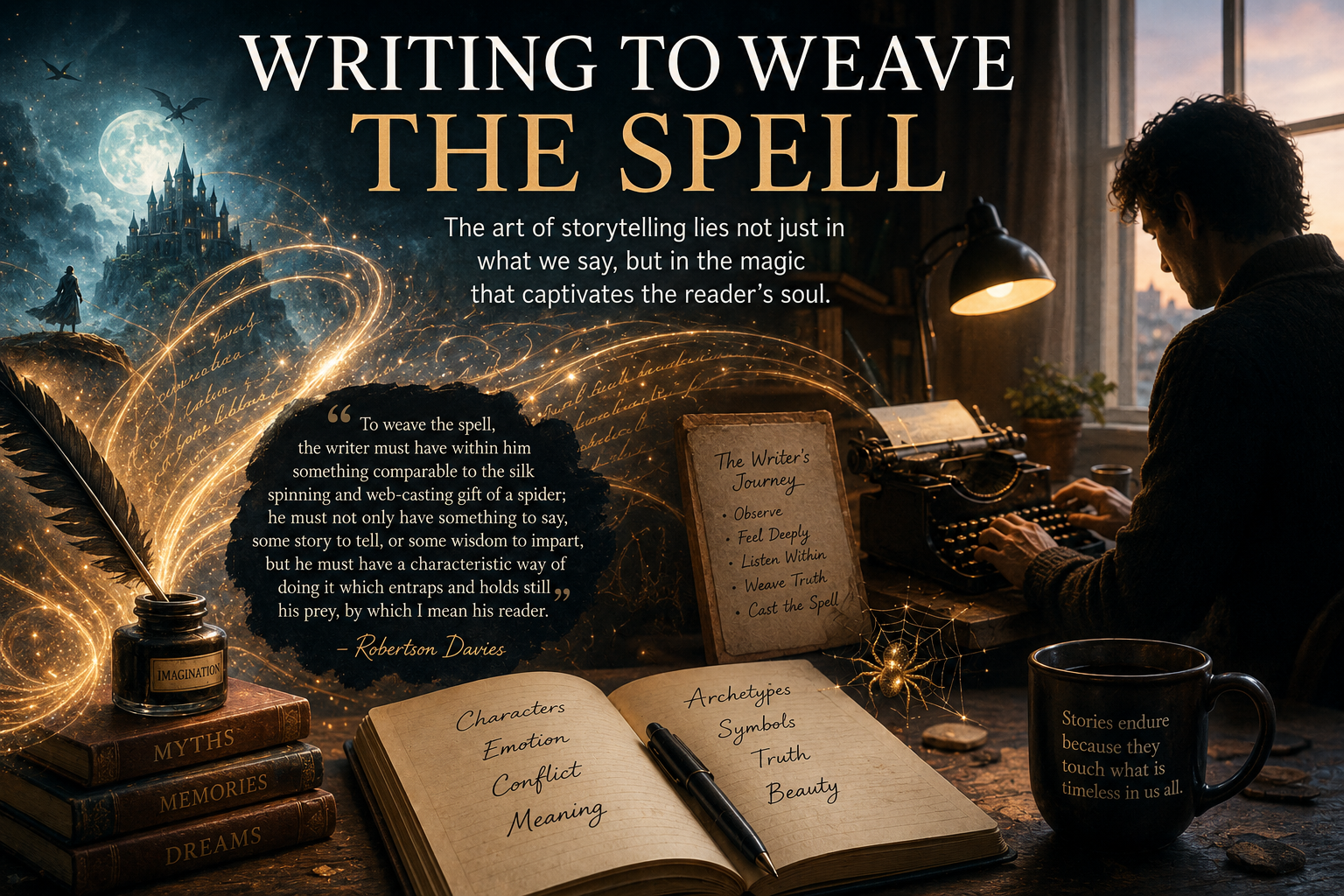
Writing To Weave The Spell
Every writer has experienced it.
You open a novel and, within a few sentences, the world around you disappears. The room fades. Time slows. Something in the rhythm of the language, the atmosphere of the story, or the emotional gravity of the voice pulls you completely into another reality.
That kind of writing feels almost supernatural.
It is not merely good storytelling. It is enchantment.
Robertson Davies understood this better than most writers. In a 1990 Tanner Lecture delivered in New Haven, Connecticut, Davies explored the mysterious qualities that separate ordinary writing from literature capable of enduring for generations. The lectures, titled Writing and Reading, examined not simply craft, but the deeper forces that allow stories to transcend time itself.
What makes a novel survive long after its era has passed? Why do some books remain alive a century later while countless others disappear almost immediately?
Davies believed the answer rested in something far more elusive than technical skill.
He called it shamanstvo.
Start building your writing career with Scrivener.
The Writer as Spellcaster
Davies described shamanstvo as a kind of innate enchantment possessed by certain writers. He compared it to the instinctive web-spinning ability of a spider.
“To weave the spell, the writer must have within him something comparable to the silk spinning and web-casting gift of a spider; he must not only have something to say, some story to tell, or some wisdom to impart, but he must have a characteristic way of doing it which entraps and holds still his prey, by which I mean his reader.”
It is one of the most powerful descriptions of writing ever expressed because it captures something every reader instinctively understands but few writers can explain.
A great writer does not merely communicate information.
A great writer captures consciousness.
The story becomes a web, and the reader willingly walks into it.
This is not simply about plot twists or cliffhangers. Plenty of books are exciting without being unforgettable. Davies was pointing toward something deeper, a kind of literary gravity that pulls readers inward through voice, atmosphere, emotional truth, and psychological resonance.
Some writers possess the rare ability to make readers feel that the story knows them personally.
That is the spell.
Beyond the “Page Turner”
Modern publishing often celebrates books that move quickly. We praise novels for being “unputdownable,” fast-paced, addictive, or cinematic. While those qualities certainly have value, Davies seemed to suggest that true literary enchantment operates differently.
A genuinely powerful book is not necessarily rushed through.
Often, it is lingered over.
Readers pause after passages. They reread sentences. They savor images, ideas, and emotional undercurrents. The experience becomes immersive rather than merely entertaining.
The difference lies in depth.
A conventional thriller may compel a reader to keep turning pages because they want to know what happens next. But enchanted writing makes the reader want to remain inside the language itself.
The reader is not chasing the ending.
They are inhabiting the experience.
That distinction matters.
Because stories that endure for generations are rarely remembered only for their plots. They survive because of atmosphere, emotional truth, voice, symbolism, and the strange feeling that the story somehow reflects universal aspects of human experience.
The Silk Comes From Within
Davies’ spider metaphor remains especially fascinating because it suggests that writing is not entirely mechanical.
The spider does not consciously invent silk.
It produces silk naturally because web-building is embedded within its nature.
Likewise, writers often discover that their most powerful work emerges not from rigid calculation but from something deeper and more instinctive within themselves.
Every writer brings a private universe to the page:
-
memories
-
fears
-
desires
-
wounds
-
dreams
-
obsessions
-
contradictions
-
longings
These internal experiences become the raw material from which stories are spun.
The challenge is not simply having experiences. Every human being has experiences.
The challenge is transforming those experiences into language that resonates beyond the self.
That transformation is where artistry begins.
Readers are rarely captivated by facts alone. They are captivated by emotional authenticity. They respond to writing that feels alive with human truth.
The writer’s inner life becomes the thread from which the web is woven.
Start building your writing career with Scrivener.
The Mystery of Universal Connection
This raises an important question.
If every writer’s experiences are personal, how can a story connect deeply with thousands or even millions of strangers?
How can deeply individual emotions become universally recognizable?
The answer may lie in the ideas of Swiss psychiatrist Carl Jung and his theory of the collective unconscious.
Jung believed that beneath our personal memories exists a deeper psychological layer shared by all humanity. Within this collective unconscious live archetypes, myths, symbols, emotional patterns, and primal human experiences inherited across generations.
According to this view, people across cultures and time periods respond to certain themes because those themes already exist deep within the human psyche.
This helps explain why stories involving:
-
love
-
betrayal
-
sacrifice
-
transformation
-
fear
-
redemption
-
loss
-
heroism
-
mortality
continue to resonate universally regardless of historical period or geography.
Writers who tap into these deeper emotional and symbolic layers often produce work that feels timeless.
The reader may not consciously understand why a story affects them so deeply. They simply recognize something within it.
Not intellectually.
Instinctively.
The Writer’s Access to the Inner World
This idea brings us back to shamanstvo.
Historically, shamans were believed to possess access to hidden realms beyond ordinary perception. They acted as intermediaries between visible and invisible worlds, translating mysteries into forms others could understand.
Davies seems to suggest that certain writers function similarly.
Not literally, of course.
But metaphorically, the writer enters emotional, symbolic, and psychological territories that many people sense but cannot articulate themselves.
The writer returns carrying stories, images, truths, and insights gathered from those inner landscapes.
The result is writing that feels strangely familiar even when readers encounter it for the first time.
Davies did not necessarily believe writers consciously decode mystical revelations. In fact, he suggested something subtler and perhaps more profound.
Great writers often tell readers things they already know deep down but have never fully expressed to themselves.
That recognition creates emotional impact.
The reader does not merely learn something new.
The reader remembers something ancient.
Start building your writing career with Scrivener.
Can This Kind of Writing Be Learned?
This is where Davies becomes both inspiring and intimidating.
He appeared to believe that some people simply possess shamanstvo while others do not. Certain writers naturally command language, atmosphere, symbolism, and emotional resonance in ways that cannot be entirely taught.
That may sound discouraging.
But perhaps the reality is more nuanced.
While innate talent undoubtedly exists, writers can still cultivate greater access to imagination, intuition, emotional honesty, and symbolic thinking.
The creative mind often operates beneath conscious logic.
Dreams, memories, sudden insights, emotional reactions, and unconscious associations all contribute to the writing process. Many writers describe moments when stories seem less invented than discovered.
Ideas arrive unexpectedly.
Characters speak without planning.
Scenes emerge fully formed from somewhere difficult to explain.
Creativity frequently behaves more like exploration than construction.
Start building your writing career with Scrivener.
Dreams, Imagination, and the Creative Mind
Toward the end of his discussion, Davies touches indirectly upon dreams and the unconscious mind.
This is significant because dreams have long been associated with creativity, mythology, symbolism, and artistic inspiration. Throughout history, writers, poets, musicians, and painters have drawn inspiration from dream imagery and unconscious thought.
Dreams bypass ordinary logic.
They speak through symbols, emotions, fragments, archetypes, and unexpected connections.
In many ways, dreams resemble literature itself.
Both operate through image, emotion, metaphor, and psychological truth.
Perhaps this is why periods of rest, reflection, solitude, or even creative inactivity can sometimes produce breakthroughs. When the conscious mind relaxes its control, deeper imaginative material has space to emerge.
Writers often discover solutions to story problems not while actively forcing answers, but while walking, resting, sleeping, or drifting mentally elsewhere.
The unconscious mind continues working even when conscious effort stops.
The Enduring Power of Enchanted Writing
The greatest stories survive because they touch something enduring within human nature.
Long after cultural trends fade, technology changes, and societies evolve, people continue searching for meaning, connection, identity, love, purpose, and transcendence. Stories that speak authentically to those universal experiences retain their power across generations.
That is why certain novels never disappear.
They continue casting the spell.
Robertson Davies’ concept of shamanstvo reminds writers that technical skill alone is not enough. Structure, grammar, pacing, and dialogue matter greatly, but the deeper magic of literature emerges from something more difficult to define.
It comes from voice.
From emotional truth.
From psychological depth.
From imagination.
From the mysterious ability to transform private experience into universal recognition.
In the end, perhaps the writer’s task is not merely to invent stories, but to listen closely enough to hear what already lives beneath the surface of human experience.
And then, somehow, weave it into words. Start your writing career today with Scrivener.
Recommended Resources
👉 Scrivener — the ultimate writing tool for authors.