Disclosure: This site may contain affiliate links. If you purchase through these links, we may earn a commission at no additional cost to you.
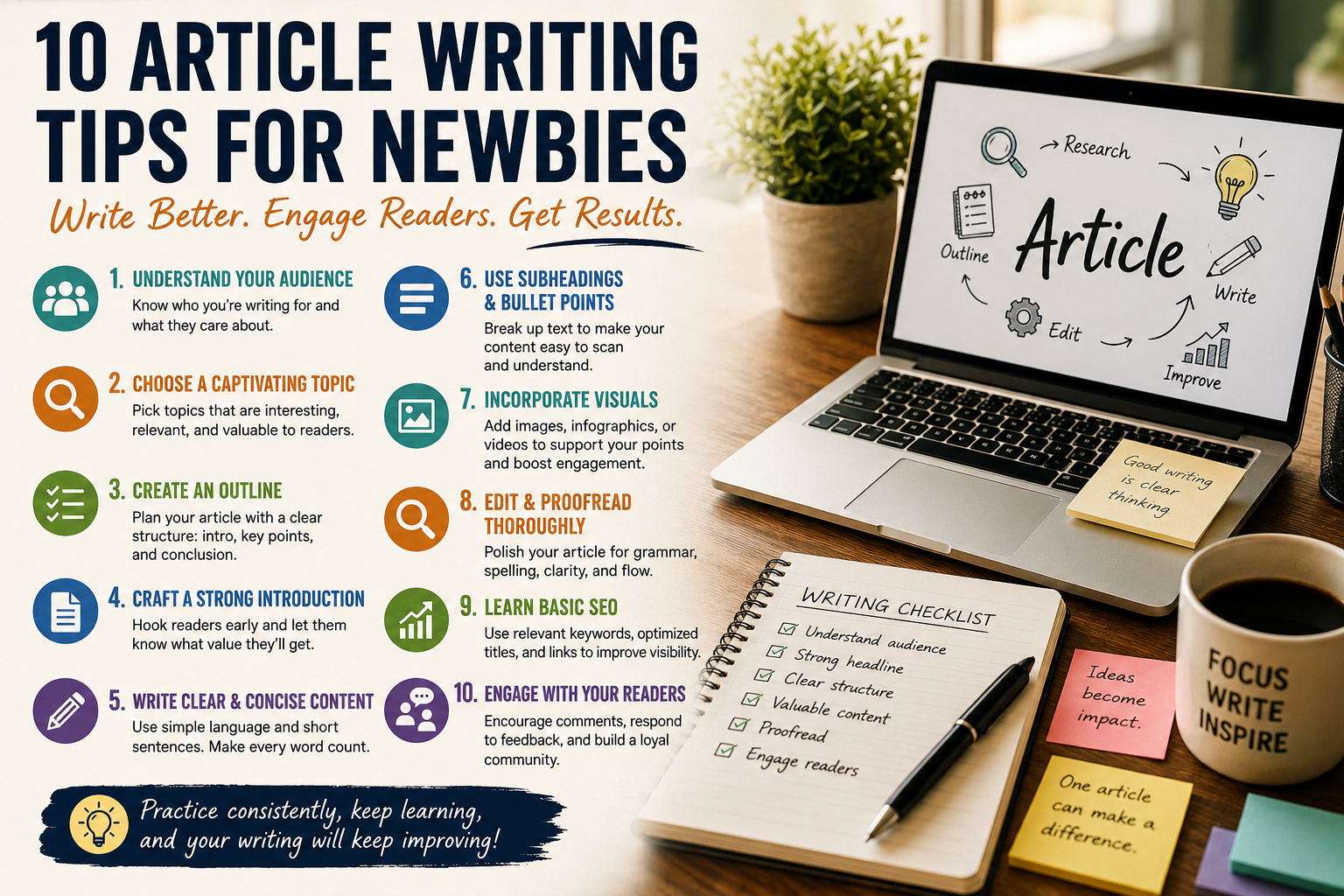
10 Article Writing Tips Every New Writer Should Know
10 Article Writing Tips Every New Writer Should Know
Writing articles may look simple from the outside, but producing content that readers actually want to finish is a skill that takes time to develop. Every successful article combines structure, clarity, creativity, and purpose in a way that feels effortless to the reader. For beginners, learning how to balance those elements can feel overwhelming at first.
The good news is that strong article writing is not reserved for professional journalists or experienced authors. Like any skill, writing improves through practice, observation, and refinement. Most successful writers started exactly where every beginner starts: staring at a blank page and wondering how to turn ideas into something worth reading.
Whether you want to build a blog, grow an online business, write professionally, or simply improve your communication skills, understanding the fundamentals of article writing can dramatically improve the quality of your work.
The following ten writing tips provide a strong foundation for beginners looking to write more engaging, polished, and effective articles.
1. Understand Your Audience Before You Start Writing
One of the biggest mistakes new writers make is writing without a clear understanding of who they are speaking to.
Every audience has different expectations, interests, knowledge levels, and problems they want solved. An article written for experienced professionals will look very different from one written for casual readers or beginners.
Before writing, ask yourself:
-
Who is this article for?
-
What problem are they trying to solve?
-
What information are they looking for?
-
What tone will resonate with them?
-
How familiar are they with the topic?
Scrivener is the perfect place to keep your efforts organized!
Understanding your audience helps shape everything from vocabulary and structure to examples and explanations.
For example, a technology article written for software engineers may include industry terminology and technical detail. The same topic written for general readers would need simpler explanations and more approachable language.
When readers feel understood, they are far more likely to continue reading and trust your content.
2. Choose a Topic That Is Both Interesting and Useful
Strong articles begin with strong topics.
New writers often choose subjects that are either too broad or too vague. A focused topic is almost always more effective than a general one because it gives readers a clear reason to click and continue reading.
Instead of writing:
-
“Fitness Tips”
try narrowing it to:
-
“10 Beginner Fitness Habits That Actually Work”
Specific topics create clearer expectations and make articles easier to structure while using Scrivener.
At the same time, the topic should provide value. Readers usually search for content because they want answers, solutions, guidance, entertainment, or insight.
Trending topics can help attract attention, but usefulness keeps readers engaged.
Good article ideas often come from:
-
frequently asked questions
-
personal experiences
-
online discussions
-
search engine trends
-
reader comments
-
industry news
-
common problems within a niche
The best topics usually sit at the intersection of reader interest and writer enthusiasm.
3. Create an Outline Before Writing
Many beginners skip outlining because they are eager to start writing immediately. However, an outline is one of the simplest ways to improve organization and reduce frustration during the writing process.
An outline acts as a roadmap.
Without structure, articles often become repetitive, unfocused, or difficult to follow. An outline keeps your ideas organized and helps ensure your content flows logically from one point to the next.
A simple article outline usually includes:
-
Introduction
-
Main sections
-
Supporting points
-
Conclusion
Breaking the article into sections also makes writing feel less intimidating. Instead of facing an entire blank page, you focus on completing one section at a time.
Well-structured articles are easier for readers to follow and easier for writers to complete while using Scrivener.
4. Write Introductions That Capture Attention
The introduction determines whether most readers continue reading or leave the page.
Online readers make quick decisions. If the opening paragraph feels dull, confusing, or irrelevant, many will move on immediately.
Strong introductions accomplish three things:
-
Grab attention
-
Introduce the topic
-
Explain why the article matters
Good opening techniques include:
-
surprising statistics
-
interesting questions
-
bold statements
-
relatable problems
-
vivid descriptions
-
short stories
The goal is not clickbait. The goal is curiosity.
Readers should quickly understand what the article is about and what value they will gain by continuing.
A strong introduction creates momentum that carries readers into the rest of the article.
5. Focus on Clarity and Simplicity
Clear writing almost always outperforms complicated writing.
Many beginners mistakenly believe complex vocabulary makes their writing sound more professional. In reality, overly complicated language often weakens readability and confuses readers.
Strong writing is direct, concise, and easy to understand.
Instead of trying to sound impressive, focus on communicating ideas clearly.
Ways to improve clarity include:
-
using shorter sentences
-
avoiding unnecessary jargon
-
eliminating filler words
-
using active voice
-
keeping paragraphs concise
-
focusing on one idea at a time
For example:
Instead of:
“The implementation of effective communication methodologies can facilitate organizational productivity.”
Write:
“Clear communication improves productivity.”
Simple writing is not weak writing. It is effective writing.
6. Use Subheadings to Improve Readability
Modern readers scan content before committing to reading it fully.
Large blocks of uninterrupted text can feel overwhelming, especially online. Subheadings break articles into manageable sections and help readers quickly locate information.
Good subheadings:
-
improve organization
-
increase readability
-
guide readers through the article
-
improve SEO performance
-
make content visually appealing
Bullet points and numbered lists also improve readability by making information easier to digest.
Articles that are visually organized tend to keep readers engaged longer because they feel less mentally exhausting to read.
7. Add Visuals Whenever Possible
Visual elements can significantly improve article engagement.
Images, infographics, charts, screenshots, and videos help:
-
break up text
-
illustrate concepts
-
improve retention
-
increase visual interest
-
simplify complex information
Readers process visual information quickly, which makes visuals especially useful for tutorials, guides, and educational content.
For example:
-
fitness articles may include exercise photos
-
travel articles may feature destination images
-
marketing articles may use charts or data graphics
Quality matters. Blurry or irrelevant visuals can hurt credibility rather than improve it.
Whenever possible, visuals should directly support the topic being discussed.
8. Edit More Than You Think You Need To
First drafts are rarely final drafts.
Strong writing often emerges during editing rather than initial creation. Even experienced writers revise extensively before publishing.
Editing improves:
-
clarity
-
grammar
-
sentence flow
-
structure
-
readability
-
consistency
One of the best editing techniques is stepping away from the article before reviewing it again. Distance helps you spot awkward phrasing and mistakes more easily.
Reading aloud is another powerful editing tool because it reveals:
-
repetitive wording
-
unnatural rhythm
-
confusing sentences
-
grammatical errors
Grammar-checking tools can help, but they should not replace careful human editing.
Well-edited articles feel smoother, cleaner, and more professional with Scrivener.
9. Learn Basic SEO Principles
Search engine optimization (SEO) helps articles become discoverable online.
Even excellent content may struggle to attract readers if it is not optimized for search visibility.
Basic SEO practices include:
-
using relevant keywords naturally
-
writing strong titles
-
optimizing headings
-
creating compelling meta descriptions
-
using internal and external links
-
optimizing image alt text
However, good SEO should never damage readability.
Keyword stuffing and robotic phrasing create poor user experiences. Modern SEO works best when quality writing and search optimization work together naturally.
Ultimately, search engines reward content that genuinely helps readers.
10. Engage With Your Readers
Writing online is not just publishing, it is conversation.
Encouraging reader interaction helps build trust, community, and long-term audience loyalty.
Ways to engage readers include:
-
asking questions
-
inviting comments
-
responding to feedback
-
encouraging social sharing
-
including calls to action
-
starting discussions
When readers feel acknowledged, they are more likely to return for future content.
Engagement also provides valuable insight into what readers care about most, helping writers improve future articles.
Writing Improves Through Practice
One of the most important things new writers should remember is that improvement takes time.
Every article teaches something:
-
how to structure ideas
-
how to communicate more clearly
-
how to engage readers
-
how to edit effectively
-
how to develop a stronger voice
No writer begins as an expert.
Consistency matters far more than perfection. Writers improve by writing regularly, studying strong content, experimenting with different styles, and learning from mistakes.
The more you write, the more natural the process becomes.
Final Thoughts
Article writing is both a creative skill and a practical skill. Strong articles combine structure, clarity, relevance, and personality in ways that connect with readers and hold attention from beginning to end.
For beginners, mastering the basics can dramatically improve confidence and results. Understanding your audience, choosing focused topics, creating clear structure, writing readable content, and editing carefully all contribute to stronger articles.
Most importantly, successful writing is not about sounding perfect.
It is about communicating ideas in ways that inform, engage, and resonate with readers.
Every great writer started as a beginner. The key is simply continuing to write and use Scrivener.
About the Author: Earnest Sherrill
Earnest Sherrill is a passionate outdoor enthusiast and writer who resides in the warm and breezy state of Texas. With a deep love for nature, Earnest enjoys exploring the great outdoors and sharing his experiences through his writing. He writes about various aspects of outdoor life and the intriguing happenings of everyday experiences. When not writing, Earnest cherishes spending time with his youngest grandchildren, who bring vibrant energy and robust attitudes to his life. Stay connected with Earnest to discover more about the wonders of the outdoors and the joys of life's adventures.
Recommended Resources
👉 Scrivener - the ultimate writing tool for authors.