Disclosure: This site may contain affiliate links. If you purchase through these links, we may earn a commission at no additional cost to you.
The Day I Became Someone I Didn't Recognize

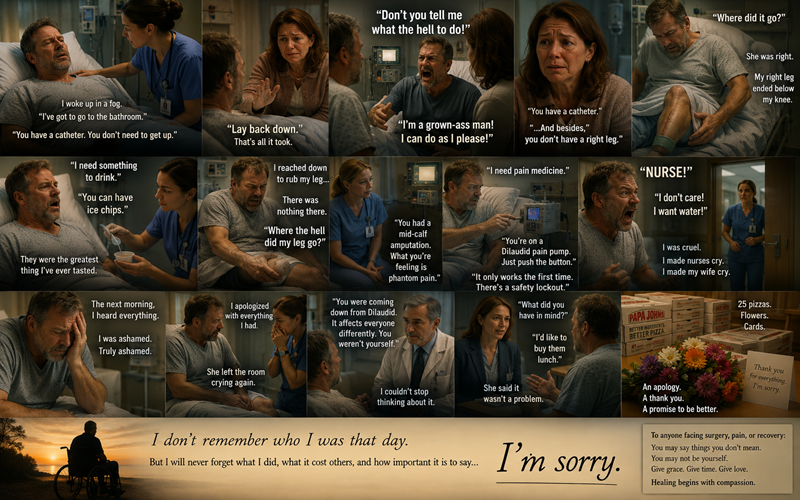
The first time I woke up after surgery, I looked around in a fog and realized I was in a hospital room. My mouth was dry, my head felt heavy, and my bladder felt like it was about to burst.
"I've got to go to the bathroom," I mumbled as I tried to climb out of bed.
A nurse immediately put her hand on my shoulder and gently pushed me back down.
"You have a catheter," she said. "You don't need to get up."
I remember looking at her with a confused expression, then everything faded away again. I was back asleep before I could even process what she had said.
The next time I woke up, I was absolutely convinced it was the following morning. I felt clearer than before, sat up in bed, and turned to swing my legs over the side so I could go to the restroom.
Before I could stand, my wife spoke from behind me.
"Lay back down."
That was all it took.
For reasons I still can't fully explain, something inside me snapped.
"Don't you tell me what the hell to do!" I yelled.
I wasn't just irritated. I was furious.
"I'm a grown-ass man! I can do as I please!"
I unloaded on the one person who had been sitting faithfully beside me through everything. I cursed. I shouted. I told her to leave and not come back if she wasn't going to let me get up.
She never raised her voice.
She simply waited for me to stop and quietly said,
"You're wearing a catheter. You don't have to get up."
Then she paused.
"And besides... you don't have a right leg."
Everything went silent.
I looked down.
She was right.
My right leg ended below my knee.
"Where did it go?" I asked quietly.
She looked at me with tears in her eyes.
"Don't you remember? Your foot turned black. The doctors had to amputate it."
I searched my memory, trying to put together pieces that simply weren't there. Nothing made sense. The events before surgery felt like they belonged to someone else.
Before I could think much longer, another feeling took over.
"I need something to drink."
"You can't have a drink yet," my wife said. "But you can have some ice chips."
She placed a few into my mouth, and for a moment they were the greatest thing I'd ever tasted. She sat back down beside my bed and tried talking to me again.
I never heard most of what she said.
I fell asleep again.
When I opened my eyes the next time, I was convinced another entire day had passed.
It hadn't.
According to everyone else, I'd only been asleep for about fifteen minutes.
My right leg was absolutely killing me.
Without thinking, I reached down to rub it.
There was nothing there.
I jerked my hand back.
"Where the hell did my leg go?"
A nurse hurried into the room.
She calmly explained that I'd undergone a mid-calf amputation and that what I was feeling was called phantom pain. At the time, the medical terminology meant absolutely nothing to me.
All I knew was that a leg that no longer existed hurt worse than anything I could imagine.
"I need pain medicine."
"You're already on a Dilaudid pain pump," she said. "Just push the button."
I pushed it.
Then I pushed it again.
Then again.
She smiled patiently.
"It only works the first time. There's a safety lockout so you can't overdose yourself."
That answer didn't make me feel any better.
I was angry.
Angry at the pain.
Angry at the confusion.
Angry at the world.
A little while later, my mouth became dry again.
Instead of pressing the nurse call button beside my bed, I did what seemed perfectly reasonable to my drug-clouded brain.
I yelled.
As loud as I possibly could.
"NURSE!"
One came running into the room.
"Sir, please lower your voice. The patient next door is dying."
"I don't care!" I shouted.
"I want something to drink! Get me some water!"
No "please."
No "thank you."
No concern for anyone else.
Only me.
Looking back now, I barely recognize that man.
He wasn't just irritable.
He was cruel.
Throughout that first day after surgery, I was awful to nearly everyone who crossed my path.
I made nurses cry.
I made my wife cry.
I'm pretty sure the people in neighboring rooms wished I'd never been admitted.
I don't remember most of it.
They do.
The following morning I finally woke up feeling like my mind had settled.
My wife quietly told me everything that had happened the previous day.
The more she talked, the worse I felt.
I couldn't believe I had treated people that way, especially her.
Later that morning, one of the nurses walked into my room.
She was the same nurse I had reduced to tears the day before.
I apologized immediately.
Not casually.
Not because I thought I should.
I apologized with everything I had.
I told her how sorry I was.
I asked if there was anything I could do to make it right.
Before she answered, tears filled her eyes again.
She quietly left the room.
That somehow made me feel even worse.
Over the rest of the day, I asked several nurses and one of the doctors what had happened to me.
One doctor finally explained it.
"You were coming down from Dilaudid," he said. "It affects everyone differently. Some people become confused. Some become emotional. Some become aggressive. You weren't yourself."
He told me not to worry about it.
That wasn't possible.
I couldn't stop thinking about it.
Eventually a patient advocate stopped by my room.
I asked if there was any way I could do something for the staff who had endured me the day before.
She smiled.
"What did you have in mind?"
"I'd like to buy them lunch."
She said she didn't see any problem with that since most of the same nurses and staff were working that day.
So that's exactly what I did.
After apologizing to my wife again, the woman who never deserved a single word I'd said, I ordered twenty-five large Papa John's pizzas in every variety they offered.
I also ordered flowers for the nurse I had made cry.
Along with the flowers, I included a handwritten card apologizing to her personally.
I sent another card to the nurses' station thanking every member of the staff who had cared for me despite the way I had treated them.
None of it erased what happened.
Nothing could.
But it was important to me that they knew the man they met on that first day wasn't the man I truly was.
Years later, I still think about that day.
Losing my leg was one of the hardest moments of my life.
But discovering that powerful medications, pain, trauma, anesthesia, and confusion could temporarily turn me into someone I didn't even recognize was almost as frightening.
If you're reading this because you've recently lost a limb, or you're sitting beside someone who has, please understand something important.
The hours immediately after surgery are often a blur.
People say things they don't mean.
They become confused.
They wake up believing it's tomorrow when only fifteen minutes have passed.
They argue.
They cry.
They hallucinate.
Some become angry.
Some become completely unlike themselves.
If that happens, don't automatically assume that's who they are.
Give them time.
Give them grace.
And if you're the patient who eventually learns what happened, do what I did.
Own it.
Apologize.
Make it right if you can.
Healing isn't just about stitches, staples, and learning to walk again.
Sometimes healing begins with saying two simple words:
"I'm sorry."