Disclosure: This site may contain affiliate links. If you purchase through these links, we may earn a commission at no additional cost to you.
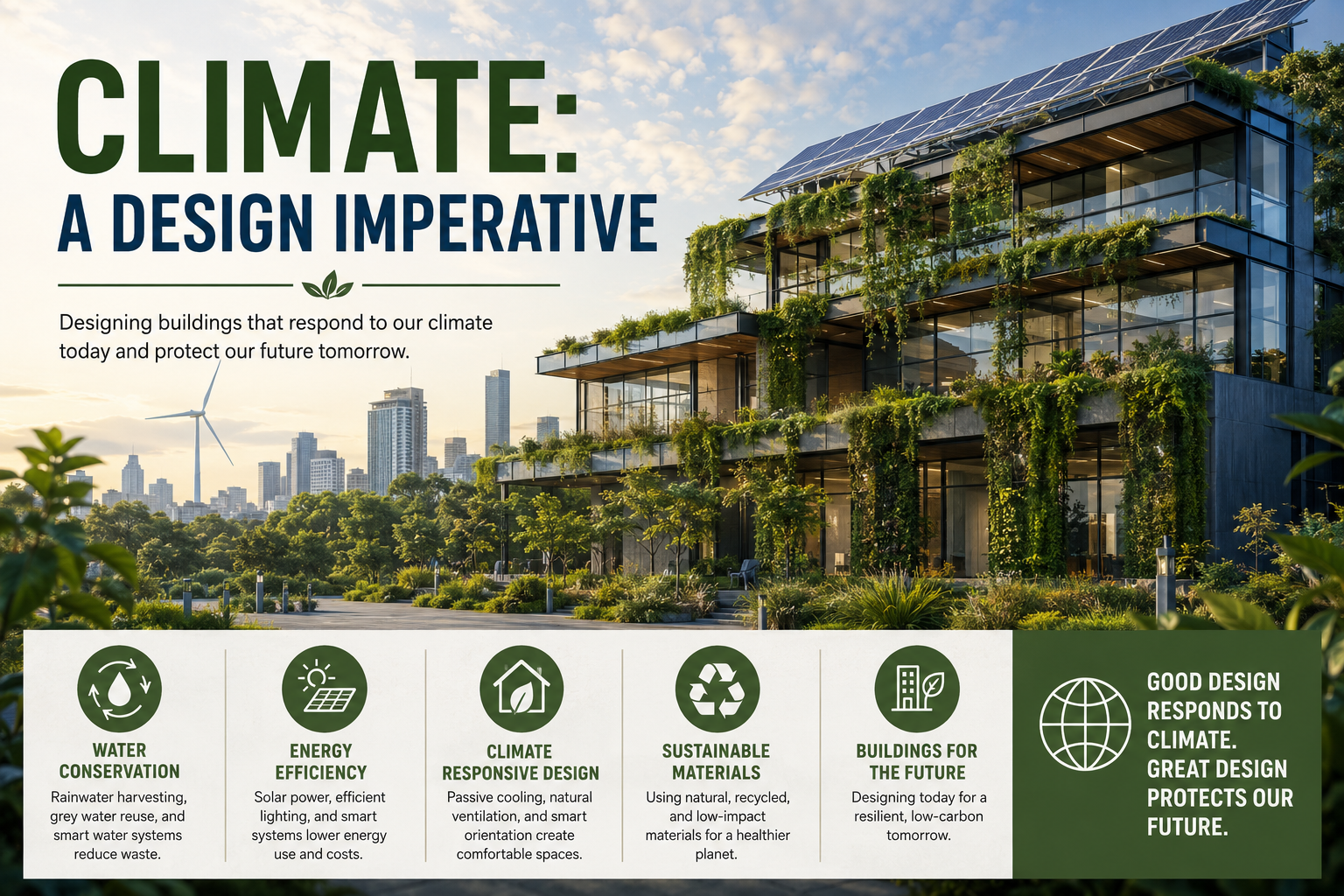
Climate: A Design Imperative
Climate has always shaped the way people build, live, and interact with their surroundings. Across different regions of the world, environmental conditions influence nearly every aspect of architecture, from the materials used in construction to the orientation of buildings, energy demands, ventilation systems, and the balance between indoor and outdoor living spaces. A structure built in a tropical coastal environment faces vastly different challenges than one designed for a cold northern climate or an arid inland region.
As climate patterns continue to shift globally, architecture and environmental design are undergoing a major transformation. Designers, architects, engineers, and governments are increasingly recognizing that buildings must not only respond to current weather conditions, but also adapt to the changing environmental realities likely to emerge during the lifespan of the structure itself. A building that ignores climatic context risks becoming inefficient, uncomfortable, expensive to maintain, and environmentally unsustainable.
Today, climate-responsive design is no longer viewed as a niche concept reserved for environmentally focused projects. It is becoming a fundamental principle of modern architecture.
The Growing Importance of Climate in Architectural Design
For decades, architects have understood the importance of designing structures that work with their natural surroundings. Orientation toward sunlight, airflow management, insulation requirements, and water control systems have always played essential roles in effective building design.
According to Michael Sandberg of Sandberg Schoffel Architects, environmental and sustainability concerns are now becoming “tremendously important” for architects and landscape designers around the world. While climate has always influenced architecture, public awareness surrounding climate-responsive design has increased dramatically due to extreme weather events, prolonged droughts, rising temperatures, and growing concerns over resource consumption.
In countries like Australia, recent climate extremes have forced both designers and the public to reconsider how buildings interact with the environment. Long-term drought conditions, water shortages, and changing seasonal weather patterns have elevated discussions surrounding sustainability from professional architectural circles into mainstream public conversation.
Architect James Russell similarly argues that effective architecture has always needed to remain “interactive with its surroundings.” However, clients and property owners are now far more receptive to environmentally responsible designs than they were in previous decades. Increasingly, homeowners and businesses are seeking structures that reduce environmental impact while lowering long-term operating costs.
This shift in awareness reflects a broader cultural movement toward sustainability, energy conservation, and environmental responsibility.
Climate Shapes Architectural Demands
Every climate zone creates unique architectural challenges. In colder regions, buildings must retain heat efficiently, withstand snow loads, and minimize energy loss. In hotter climates, ventilation, shading, cooling, and thermal control become critical priorities. Coastal environments require resistance to moisture, salt exposure, storms, and wind. Dry inland climates often demand water conservation and heat management strategies.
As a result, architecture cannot be separated from geography or climate.
Historically, countries facing harsh environmental conditions often advanced more rapidly in climate-responsive design. Scandinavian nations, for example, developed highly efficient insulation systems, energy-conscious construction techniques, and sustainable building practices partly because limited natural resources demanded greater efficiency.
Michael Sandberg notes that nations with fewer natural resources have generally been forced to innovate earlier and more aggressively in environmental design. Scandinavian countries became leaders in sustainable architecture because environmental efficiency was not optional, it was necessary.
Australia, by comparison, historically experienced less pressure to prioritize certain climate-responsive measures. The country’s warmer climate and historically abundant natural resources reduced the urgency for extensive insulation systems, advanced waterproofing techniques, and energy conservation strategies. As Sandberg explains, Australia “lagged” behind some other nations in adopting environmentally responsive architecture because the environmental pressures were less immediate.
However, that situation has changed dramatically in recent years.
Australia’s Changing Climate and the Push Toward Sustainability
Australia’s increasingly extreme climate conditions have accelerated the demand for sustainable architecture and environmental design. Extended droughts across southern and eastern regions of the country have heightened concerns surrounding water use, energy efficiency, and resource management.
As rainfall deficiencies became more severe, water-saving measures began influencing both residential and commercial building design. Architects and landscape designers started integrating systems focused on water retention, recycling, and conservation directly into the structure of buildings themselves.
Government regulations and restrictions on water use also played a major role in shaping public behavior. Homeowners, businesses, and developers became more conscious of how buildings consume resources during everyday operation. Sustainability was no longer viewed solely as an environmental issue; it became an economic and practical concern as well.
This growing awareness has significantly influenced architectural priorities. Modern climate-responsive buildings increasingly incorporate:
-
Rainwater harvesting systems
-
Grey water recycling
-
Energy-efficient lighting
-
Solar heating technologies
-
Improved insulation
-
Passive cooling systems
-
Natural ventilation
-
Sustainable and recyclable materials
-
Smart environmental controls
These features are designed not only to reduce environmental impact but also to improve long-term operational efficiency and reduce energy costs.
Architecture is increasingly being viewed as part of a larger environmental system rather than as isolated structures disconnected from their surroundings.
The Rise of Environmentally Responsive Buildings
One of the strongest examples of climate-responsive architecture in Australia is the award-winning Szencorp Building located on Albert Road in South Melbourne.
Originally built during the 1980s, the structure was redesigned in the mid-2000s with sustainability and climate adaptation as central priorities. The redevelopment transformed the aging office building into one of the most environmentally advanced commercial buildings in Australia at the time.
The redesigned Szencorp Building earned a six-star green rating from the Green Building Council of Australia (GBCA), reflecting its high level of environmental performance and sustainability innovation.
The building incorporated a wide range of environmentally conscious design elements, including:
-
Grey water recycling systems
-
Rainwater harvesting infrastructure
-
Solar hot water systems
-
Energy-efficient lighting controls
-
Environmental monitoring systems
-
Reduced energy consumption technologies
Rather than treating sustainability as an afterthought, the building integrated environmental performance directly into the architecture itself.
Projects like the Szencorp Building demonstrate how older structures can be adapted to meet modern environmental expectations. They also highlight a critical point in the sustainability discussion: improving existing buildings may be just as important as constructing new environmentally friendly developments.
Energy Efficiency as a Critical Solution
Peter Szental, principal of The Szencorp Group, believes energy efficiency remains one of the most important strategies for reducing greenhouse gas emissions and addressing long-term environmental challenges.
According to Szental, energy efficiency is often overlooked despite being one of the most cost-effective methods for lowering environmental impact. Buildings consume enormous amounts of electricity, heating, cooling, and water throughout their operational lifespan. Even modest improvements in efficiency can produce substantial environmental and financial benefits over time.
Importantly, sustainability is not solely about new technologies or futuristic building concepts. Often, it involves improving the performance of existing systems through smarter design, better materials, and more efficient energy use.
Szental also emphasizes the importance of addressing older commercial buildings, many of which continue to consume excessive resources due to outdated infrastructure and poor environmental performance.
Retrofitting older structures with improved insulation, lighting systems, water-saving technology, and renewable energy solutions may become one of the most effective ways to reduce large-scale emissions in the built environment.
The Role of Renewable and Alternative Energy
Climate-responsive architecture increasingly involves integrating multiple energy sources into building design. Designers are now exploring combinations of solar, wind, hydro, biomass, and other alternative energy systems to reduce dependence on traditional fossil fuels.
Architects and environmental planners are also recognizing that sustainable design requires cooperation between governments, industries, and communities. Incentives promoting energy efficiency, renewable energy adoption, and environmentally responsible construction can significantly accelerate progress.
As climate challenges intensify globally, buildings are being viewed not merely as shelters but as active participants within broader environmental systems.
The goal is no longer simply to construct buildings that survive within their environments. Increasingly, the objective is to create buildings that actively reduce environmental strain while supporting healthier, more sustainable communities.
A Global Architectural Response to Climate Change
The movement toward climate-responsive design is not limited to Australia. Around the world, architects, engineers, and environmental organizations are collaborating to establish sustainability standards and climate-conscious building practices.
A significant moment occurred on 18 June 2007 during the International Presidents’ Forum at the American Institute of Architects (AIA) National Convention in San Antonio. Sixteen presidents representing national and international architectural associations united to address the role of design in responding to global climate change.
The forum produced a shared commitment to international sustainability goals and environmental benchmarks within architectural design.
This collaboration reflected a growing global understanding that architecture plays a critical role in addressing climate challenges. Buildings account for substantial portions of global energy consumption, greenhouse gas emissions, and resource use. As a result, the design community increasingly recognizes its responsibility to help shape more sustainable futures.
The Future of Climate-Responsive Architecture
The future of architecture will likely be defined by adaptability, sustainability, and environmental integration. Climate-responsive design is rapidly evolving from a specialized discipline into a foundational expectation across residential, commercial, and public construction.
Future buildings will need to address rising temperatures, water shortages, energy demands, severe weather events, and changing environmental conditions. At the same time, they must remain comfortable, functional, and economically viable for the people who use them.
Advances in smart technology, renewable energy integration, sustainable materials, and environmental engineering will continue shaping how buildings are designed and operated.
Ultimately, climate-responsive architecture is about more than reducing environmental impact. It is about creating spaces that function intelligently within their surroundings, conserve resources responsibly, and remain resilient in the face of an uncertain environmental future.
Climate is no longer simply a consideration in architecture. It has become one of the defining imperatives of modern design.
Recommended Resources
👉 Duluth Pack — premium outdoor bags and packs.
👉 Sportsman's Warehouse — outdoor gear, hunting, and fishing supplies.